Tensile Testing Service for Filament Strands – Accredited Strength and Elongation Assessment for Fine Fibres, Monofilaments, and Yarns
For Belgian manufacturers, textile engineers, composite material producers, and quality managers in the technical textile, medical device, automotive, and 3D‑printing sectors, the tensile properties of filament strands – including monofilaments, multifilament yarns, and fine wires – are fundamental to product performance, processability, and end‑use reliability. Our ISO/IEC 17025 accredited laboratory offers a specialised tensile testing service for filament strands that precisely measures breaking force, tenacity, elongation at break, initial modulus, and work‑to‑break on individual filaments or small yarn bundles, using high‑sensitivity tensile frames, pneumatic grips, and non‑contact extensometry. With decades of experience in fibre characterisation and a deep understanding of the challenges posed by fine, fragile, or slippery specimens, we provide data that directly supports material selection, quality control, and regulatory compliance. Our BELAC‑accredited reports are recognised by the Belgian Federal Public Service (FOD Economie), notified bodies, and authorities under the Personal Protective Equipment Regulation (EU 2016/425), the Medical Devices Regulation (EU 2017/745), the REACH Regulation (EC 1907/2006), and the relevant harmonised standards for textiles and composites.
Filament Types and Products We Regularly Test
We accept a broad range of filamentary materials, from single‑end monofilaments to complex multifilament yarns, with diameters ranging from a few micrometres to several millimetres. Our grip systems are designed to prevent slippage or damage during clamping, ensuring that the measured properties reflect the true filament strength. Common specimens include:
- Synthetic monofilaments – nylon (polyamide), polyester (PET), polypropylene (PP), polyethylene (PE), PTFE, PEEK, and PVDF.
- Multifilament yarns – continuous filament yarns for weaving, knitting, and braiding, in various polymer types.
- High‑performance fibres – aramid (Kevlar, Twaron), ultra‑high molecular weight polyethylene (UHMWPE, Dyneema, Spectra), carbon fibre tows, and glass fibre strands.
- Elastomeric filaments – spandex (elastane), rubber threads, and thermoplastic elastomer monofilaments.
- Bicomponent and speciality filaments – sheath‑core, side‑by‑side, and segmented‑pie configurations.
- Metallic and conductive wires – fine copper, silver, gold, and stainless‑steel wires for electronic and textile applications.
- Natural and regenerated filaments – silk, viscose, lyocell, and bamboo‑based continuous filaments.
- Additive manufacturing filaments – 3D‑printing filaments (PLA, ABS, PETG, TPU, nylon) for fused deposition modelling.
- Medical and surgical sutures – absorbable and non‑absorbable monofilament and braided sutures.
Core Tensile Test Methods – Breaking Force, Tenacity, and Elongation
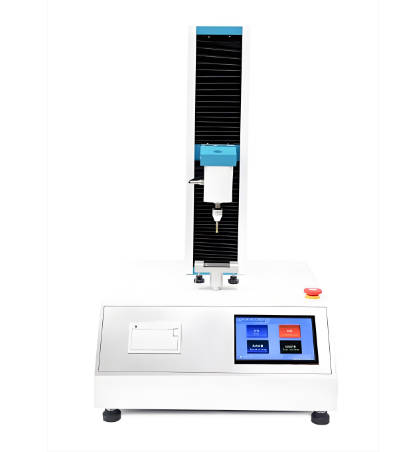
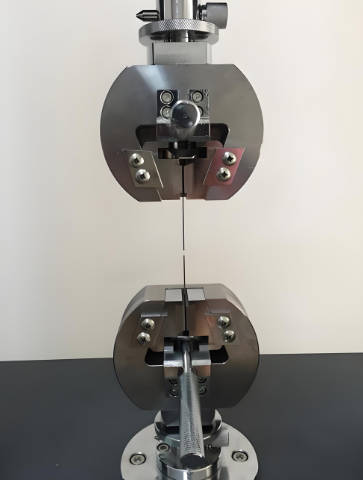
Our tensile testing service for filament strands follows the most widely recognised international and European standards, adapted specifically for the unique behaviour of fine filamentary materials. We use constant‑rate‑of‑extension (CRE) tensile testing machines equipped with sensitive load cells (from 1 N to 5 kN) and pneumatic grips with flat or serrated faces to minimise slippage:
- Monofilament tensile test – according to ISO 2062 (Textile glass – continuous filament yarns), ASTM D2256 (Standard test method for tensile properties of yarns), and EN ISO 2062, with Belgian NBN implementation – We prepare individual filaments by carefully mounting them in the grips with a defined gauge length (typically 250 mm or 500 mm). The specimen is extended at a constant rate (typically 250 mm/min) until rupture. The breaking force (in N or cN), the elongation at break (in mm or %), and the initial modulus (in cN/tex or GPa) are measured. For fine monofilaments (< 0.1 mm diameter), we use low‑capacity load cells and special grip linings to prevent damage.
- Yarn tensile test (multifilament) – according to ISO 2062, ASTM D2256, and EN ISO 2062 – For multifilament yarns, we test a representative strand of the yarn (e.g., a single end) or, for very fine yarns, a small bundle of filaments. The test is performed with a specified pre‑tension and a gauge length of 500 mm. The results are expressed in terms of breaking force (N), tenacity (cN/tex or N/tex), elongation at break (%), and initial modulus.
- Determination of tenacity (specific strength) – we calculate the tenacity by dividing the breaking force by the linear density (tex) of the filament, which is determined by weighing a known length of the filament under controlled conditions – Tenacity is a material‑independent measure of strength, allowing direct comparison of filaments with different diameters or densities.
- Work‑to‑break and toughness – we integrate the force‑extension curve to obtain the work‑to‑break (in J or cN·cm), and we divide by the linear density to obtain the specific work‑to‑break (in J/tex), which is a measure of the filament's toughness and energy absorption capacity.
- Secant modulus and chord modulus – we calculate the modulus of elasticity from the initial linear region of the force‑extension curve (or stress‑strain curve) at defined strain levels (e.g., between 0.1% and 0.3% strain) to characterise the stiffness of the filament.
Specialised Test Variants – Temperature, Speed, and Environmental Effects
Filament tensile properties are highly dependent on test conditions. We offer a range of specialised test protocols that simulate actual processing or service environments:
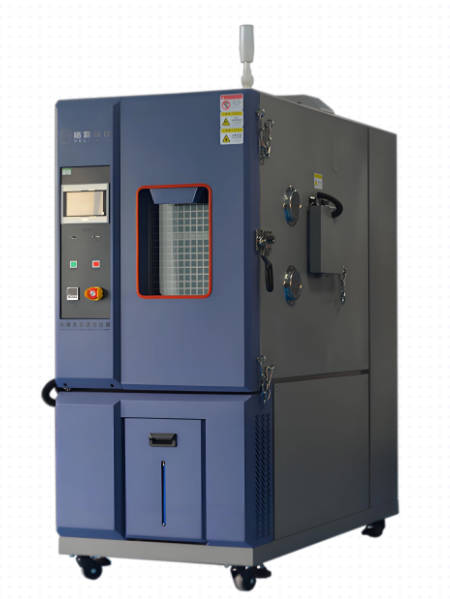
- High‑temperature tensile test – for filaments used in automotive, aerospace, or high‑temperature processing – according to ASTM D2256 (with thermal chamber), ISO 2062 (annex for elevated temperature), and EN ISO 2062 – We condition the specimen at the target temperature (up to 250°C) and perform the tensile test within the chamber, measuring the thermal degradation of breaking force and modulus.
- Low‑temperature tensile test – for filaments used in cold environments or cryogenic applications – down to ‑60°C – We use a refrigerated chamber to test the filament at low temperatures, evaluating the embrittlement and loss of ductility.
- Dynamic and high‑speed tensile testing – for filaments subject to impact or rapid processing (e.g., weaving, braiding) – We perform the test at higher crosshead speeds (up to 1,000 mm/min) to assess the strain‑rate sensitivity of the filament.
- Wet tensile test – for filaments that will be used in humid or aqueous environments (e.g., sutures, fishing lines, wet‑laid nonwovens) – We immerse the specimen in water (or a conditioned environment) for a specified time and perform the tensile test in the wet state. The wet strength retention (percentage of dry strength) is reported.
- Conditioned tensile test – at standard atmospheric conditions (ISO 139, 20°C, 65% RH) and at tropical conditions (30°C, 90% RH) – We condition the specimens to the specified environment and test them at the same conditions to evaluate the effect of moisture and temperature on the tensile properties.
Grip Selection and Sample Handling – Avoiding Slippage and Damage
For filament strands, proper gripping is the most critical factor for obtaining valid test results. We employ a variety of grip technologies to handle different filament types, ensuring that failure occurs within the gauge length and not at the grips:
- Pneumatic grips with serrated faces – for medium‑diameter monofilaments and yarns – The grip pressure is adjusted to prevent slippage without crushing the filament.
- Flat rubber‑faced grips – for smooth or slippery filaments (e.g., PTFE, UHMWPE, silk) – The rubber lining provides a high coefficient of friction and prevents damage to the filament surface.
- Capstan grips (wrapped around a pin) – for very fine or delicate filaments (e.g., carbon fibre tows, glass fibre strands) – The filament is wrapped around a mandrel before being clamped, distributing the clamping force and eliminating stress concentrations.
- Adhesive‑backed tabs – for brittle or fragile filaments that are sensitive to clamping – The filament is glued or taped to a paper or plastic tab, which is then clamped in the grips, ensuring that the filament is not directly subjected to the clamping pressure.
- Grip pressure monitoring – we continuously monitor the grip pressure and adjust it based on the filament type, ensuring consistent clamping force across all specimens – This is particularly important for filaments that are sensitive to damage under high pressure.
Linear Density Determination – Tex, Denier, and Decitex Measurement
Accurate linear density (mass per unit length) is essential for calculating tenacity and modulus. We determine the linear density using a calibrated balance and a precise length‑measuring device, following standard procedures:
- Determination of linear density by weighing a known length – according to ISO 2060 (Textile glass – yarns), ASTM D1907 (yarns), and EN ISO 2060 – We cut a known length of the filament (typically 100 m, 200 m, or 500 m) and weigh it on a precision balance (accuracy 0.1 mg). The linear density is calculated in tex (g/km) or denier (g/9000 m). For monofilaments, we also measure the diameter using a calibrated optical microscope or a laser micrometer to calculate the cross‑sectional area and derive the stress (in MPa) for fundamental material characterisation.
- Measurement of diameter – for round monofilaments – using a laser micrometer (accuracy ±1 µm) or an optical comparator – We take multiple readings along the length to account for diameter variations, and we calculate the average diameter and the coefficient of variation.
- Correction for twist – for twisted yarns, we determine the linear density of the untwisted filament (or we use the direct weighing method on the twisted yarn, with the appropriate conversion) – The twist influences the measured linear density; we apply the required correction to obtain the true filament density.
Failure Mode Analysis and Interpretation
After each tensile test, we examine the break point and the fracture surface to understand the failure mode and to detect any anomalies. This analysis supports material development and troubleshooting:
- Visual inspection of the break – under a magnifying lens or a stereo microscope – to classify the failure as ductile (necking), brittle (fracture), or mixed – A ductile break with extensive necking indicates good toughness; a brittle break suggests low elongation and potential handling issues.
- Measurement of the broken filament diameter – to assess any necking or reduction in cross‑sectional area – A reduction in diameter indicates plastic deformation, which contributes to the toughness.
- Examination of the break location – to ensure that failure occurred within the gauge length and not at the grips – Breaks near the grips are invalid and indicate grip‑induced damage; we discard those results and repeat the test with adjusted grip conditions.
- SEM analysis (on request) – of the fracture surface to examine the micro‑mechanisms of failure (e.g., fibrillation, cavitation, or debonding) – This is particularly valuable for high‑performance fibres and for forensic investigations.
- Correlation with processing parameters – we compare the tensile data with the extrusion, drawing, or heat‑setting parameters to assist in process optimisation – For example, a higher draw ratio usually increases tenacity but reduces elongation; we can help you find the optimal balance.
Calibration, Accuracy, and Quality Assurance
All tensile tests are performed under our ISO/IEC 17025:2017 accredited quality system, with full traceability of force, displacement, time, and temperature measurements:
- Calibration of tensile testing machines – load cells and displacement sensors – according to ISO 7500‑1, ASTM E74, and EN ISO 7500‑1 – We calibrate the load cells annually with certified reference weights (class 0.5), achieving measurement uncertainties < 0.5% for forces above 10% of the cell capacity. The crosshead displacement is verified using a calibrated extensometer.
- Calibration of the grip pressure – we use a calibrated pressure gauge to set and monitor the grip pressure for each test – This ensures that the clamping force is consistent and appropriate for the filament type.
- Verification with reference filaments – we test certified reference filaments (e.g., a standard polyester or nylon monofilament with known tensile properties) at regular intervals to confirm the stability of the test system – The results are tracked on control charts to detect any drift.
- Interlaboratory comparison (ILC) – we participate in proficiency testing schemes for textile and fibre tensile testing – Our results are regularly compared with those of other accredited laboratories to ensure consistency and accuracy.
- Measurement uncertainty analysis – we report the expanded uncertainty (k=2) for breaking force, tenacity, and elongation – The uncertainty is calculated according to the GUM (Guide to the Expression of Uncertainty in Measurement) and is included in every test report.
Compliance with Belgian and European Regulations
Our filament tensile testing services support your conformity assessment under the relevant European directives and Belgian regulations for textiles, personal protective equipment, medical devices, and composite materials:
- Personal Protective Equipment Regulation (EU 2016/425) – for protective gloves, clothing, and other PPE containing textile filaments – Filament strength is a critical parameter in many PPE standards (e.g., EN 388, EN 469, EN 13034). Our tests provide the essential data for the CE marking of PPE.
- Medical Devices Regulation (EU 2017/745) – for surgical sutures, mesh implants, and other medical textiles – Filament tensile properties are part of the essential requirements for these devices; our reports are accepted by Belgian notified bodies (e.g., Vinçotte, ) for technical file submissions.
- REACH Regulation (EC 1907/2006) – for the chemical substances used in the production of filaments – The mechanical integrity of filaments is part of the safety assessment; our test data supports the evaluation of substances and their potential impact on product performance.
- Belgian national regulations – including the ARAB (General Regulation on Occupational Safety) for industrial textile products and the product‑specific rules for construction and automotive textiles – Our reports are used to verify the mechanical reliability of filament‑based products in Belgian workplaces and infrastructure.
- EU Construction Products Regulation (CPR, EU 305/2011) – for geotextiles, reinforcing textiles, and architectural membranes containing filaments – The tensile properties of filaments are directly used in the Declaration of Performance (DoP) of these products.
Reporting and Accreditation
All filament tensile tests are performed under our ISO/IEC 17025:2017 accredited quality system, with full traceability of all measurement parameters. Our BELAC‑accredited reports are recognised by the FOD Economie, Belgian notified bodies, and European authorities. Each report includes:
- A detailed description of the test specimen (type, diameter, linear density, twist, conditioning).
- The test method and standard used, with all relevant test parameters (gauge length, crosshead speed, grip type, temperature, humidity).
- The measured breaking force, tenacity, elongation at break, and modulus (with mean, standard deviation, minimum, maximum, and coefficient of variation).
- The stress‑strain curve (or force‑extension curve) in graphical and tabular format.
- Calculation of the work‑to‑break and the specific work‑to‑break (if requested).
- Failure mode analysis and photographic documentation.
- Calibration certificates and measurement uncertainty statements.
- A professional conclusion on the tensile performance of the filament and its suitability for the intended application, with recommendations for design or processing adjustments if necessary.
Our reports provide the confidence you need to certify your products, approve deliveries, and comply with all applicable regulations.
Why Choose Our Tensile Testing Service for Filament Strands?
We understand that the tensile properties of filaments are often the deciding factor in product performance – from the strength of a parachute cord to the durability of a medical suture. Our team offers rapid scheduling, flexible test programmes (from single‑specimen screening to extensive statistical studies), and clear, practical interpretation of results – we do not simply give you numbers; we explain the significance of the breaking force, the elongation, and the modulus, and we relate them to your process and application requirements. We work closely with your fibre producers, textile processors, and product designers to select the most appropriate test parameters, conditioning regimes, and acceptance criteria for your specific filament type and end‑use. With high‑sensitivity tensile frames, a variety of grip systems, environmental chambers, and a highly experienced team, our tensile testing service for filament strands delivers the accuracy, repeatability, and regulatory acceptance you need to ensure that your filament‑based materials meet the high standards of the Belgian and European market. Contact us to discuss your filament types, performance targets, and certification goals – we will design a tailored test programme that provides the definitive assessment of your filament's tensile performance.