Thermal Deformation Temperature Testing Service – Accredited Measurement of Heat Deflection Temperature (HDT) and Vicat Softening Temperature for Polymers and Composite Materials
For Belgian manufacturers, material engineers, and quality managers in the automotive, electronics, construction, and consumer goods industries, the thermal deformation temperature of a polymer or composite is a critical parameter that defines the upper limit of service temperature under mechanical load. Heat Deflection Temperature (HDT), also known as the heat distortion temperature, indicates the temperature at which a material deforms under a specified load, providing essential data for product design, material selection, and process optimisation. Our ISO/IEC 17025 accredited laboratory offers a specialised thermal deformation temperature testing service that precisely measures the HDT (at 0.45 MPa and 1.82 MPa) and the Vicat softening temperature (VST) for plastics, elastomers, and composites, in accordance with the most recognised international and European standards. With precision test frames, temperature‑controlled oil baths, and automated deflection measurement systems, we provide the reliable data you need for material qualification, quality control, and regulatory compliance. Our BELAC‑accredited reports are recognised by the Belgian Federal Public Service (FOD Economie), notified bodies, and authorities under the Low Voltage Directive (2014/35/EU), the Machinery Directive (2006/42/EC), and the relevant harmonised standards (ISO 75, ISO 306, ASTM D648, ASTM D1525, EN ISO 75, EN ISO 306, etc.).
Materials and Products We Regularly Test
We accept a wide range of polymeric materials, including thermoplastic and thermosetting plastics, elastomers, composites, laminates, and finished components. Our test equipment accommodates standard specimen geometries as defined by ISO 75 and ASTM D648, as well as custom‑shaped specimens on request. Common samples include:
- Thermoplastics – polypropylene (PP), polyethylene (PE), polyamide (PA), polycarbonate (PC), acrylonitrile‑butadiene‑styrene (ABS), polyoxymethylene (POM), PET, PBT, and polyphenylene sulphide (PPS).
- Thermosetting plastics – epoxy resins, phenolic resins, polyester resins, and polyurethane systems.
- Composites and laminates – glass‑fibre reinforced plastics (GFRP), carbon‑fibre reinforced plastics (CFRP), and other fibre‑reinforced thermosets and thermoplastics.
- Elastomers and rubbers – when they are sufficiently rigid to be tested according to the relevant standards.
- Additively manufactured parts – to evaluate the thermal deformation behaviour of 3D‑printed polymer components.
- Finished plastic components – for quality control and end‑use verification.
- Prototypes and developmental formulations – for material selection and formulation optimisation.
Core Test Methods – Heat Deflection Temperature (HDT) and Vicat Softening Temperature (VST)
Our thermal deformation temperature testing service includes both HDT and Vicat methods, providing a comprehensive assessment of the thermal resistance of your materials:
- Heat deflection temperature (HDT) – according to ISO 75‑1/75‑2, ASTM D648, and NBN EN ISO 75‑1 – We test a standard rectangular specimen (typically 80 mm × 10 mm × 4 mm) placed on two supports with a span of 64 mm. A specified load is applied to the centre of the specimen, creating a bending stress of either 0.45 MPa (Method A) or 1.82 MPa (Method B). The assembly is immersed in an oil bath with a controlled heating rate of 2°C/min. The HDT is defined as the temperature at which the specimen deflection reaches a defined value (0.25 mm for ISO 75, or 0.25 mm or 0.32 mm for ASTM D648). We report the HDT for both Method A and Method B, depending on your application requirements.
- Vicat softening temperature (VST) – according to ISO 306, ASTM D1525, and NBN EN ISO 306 – We use a flat‑ended needle (with a cross‑sectional area of 1 mm²) that is applied to the surface of a specimen under a specified load (10 N or 50 N). The assembly is heated at a constant rate (50°C/h or 120°C/h) in an oil bath. The Vicat softening temperature is the temperature at which the needle penetrates to a depth of 1 mm. This method is particularly suitable for materials that do not exhibit a sharp deflection point, such as soft thermoplastics and elastomers.
- High‑temperature HDT testing – for advanced engineering plastics with HDT above 200°C – For high‑temperature materials (e.g., PEEK, PEI, PPS, liquid crystal polymers), we use specialised silicon oil baths capable of operating up to 300°C, allowing accurate measurement of HDT for the most demanding applications.
- Low‑temperature Vicat testing – for materials used in cold environments – On request, we can perform Vicat testing at sub‑zero temperatures using a cooled oil bath to evaluate the softening behaviour at low temperatures.
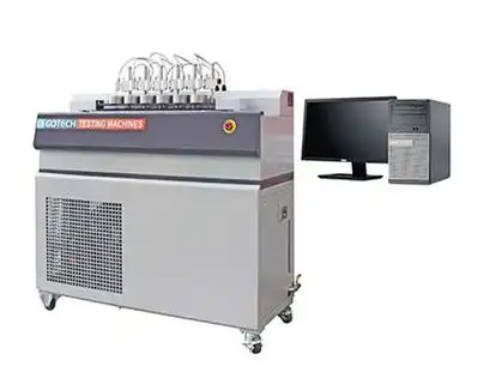
- Multiple specimen testing – we can test up to six specimens simultaneously in a single test run, providing statistical reliability and efficient use of test time – Our automated systems record the deflection and temperature for each specimen individually, and we report the average HDT or VST along with the standard deviation.
Specimen Preparation and Conditioning
Correct specimen preparation and conditioning are essential for reproducible HDT and Vicat results. We follow the preparation and conditioning procedures specified in the relevant standards:
- Specimen preparation – specimens are prepared by injection moulding, compression moulding, extrusion, or machining from a finished part. The dimensions are checked to ensure they meet the standard requirements (ISO 75 specifies 80 mm × 10 mm × 4 mm; ASTM D648 specifies 127 mm × 13 mm × 3.2 mm or 6.4 mm). We can also test specimens of alternative dimensions on request, with appropriate correction factors.
- Conditioning – according to ISO 291 and ASTM D618 – For most plastics, we condition the specimens at 23°C ± 2°C and 50% ± 5% relative humidity for at least 24 hours before testing. For hygroscopic materials (e.g., polyamide), we may apply specific drying or moisture‑conditioning procedures to simulate the expected service environment.
- Annealing (for materials with high residual stress) – for materials that may have been affected by moulding stresses, we perform an annealing step (e.g., heating to a temperature below the HDT and slowly cooling) before testing to relieve internal stresses.
- Measurement of specimen thickness – we accurately measure the thickness of each specimen at the centre of the deflection point, using a calibrated micrometer, and we verify that the thickness is within the standard tolerance (typically ±0.2 mm).
Test Equipment and Calibration
Our HDT and Vicat testing equipment is designed for high accuracy and reproducibility, with continuous temperature monitoring and automated deflection recording:
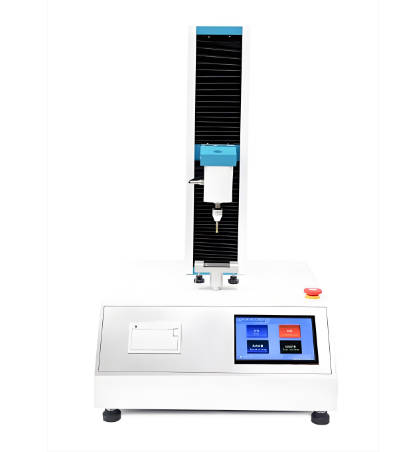
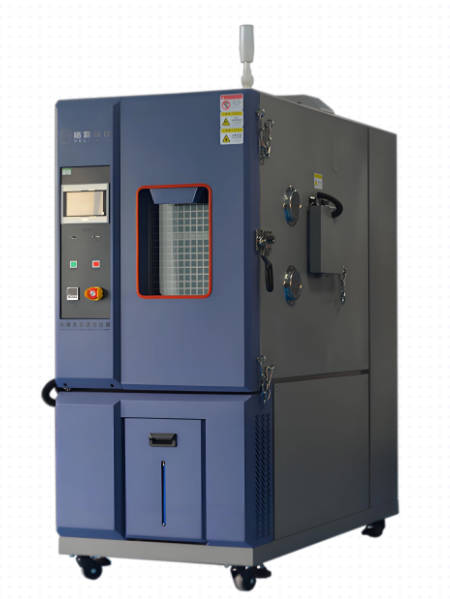
- HDT/Vicat tester – a fully automated test frame with interchangeable weights and a temperature‑controlled oil bath (up to 300°C). The system uses a precision LVDT (linear variable differential transformer) to measure the deflection or penetration with an accuracy of ±0.01 mm.
- Temperature control – the oil bath is heated with a programmable controller that ensures a linear heating rate of 2°C/min for HDT and 50°C/h or 120°C/h for Vicat. The oil temperature is continuously monitored with calibrated thermocouples (type K or PT100) placed near the specimen.
- Load application – the test load is applied through a precision weight system, with the load value verified before each test using a calibrated balance. The load is adjusted to achieve the specified stress (0.45 MPa or 1.82 MPa for HDT, and 10 N or 50 N for Vicat).
- Data acquisition – the deflection and temperature data are recorded continuously, and the system automatically determines the HDT or VST based on the defined criteria. The data are stored in a secure format and can be exported for further analysis.
- Calibration – we calibrate the temperature sensors, the deflection transducers, and the load application system annually, following ISO 17025 guidelines. The oil bath is also checked periodically for temperature uniformity and heating rate accuracy.
Specialised Testing – High‑Temperature, High‑Load, and Custom Geometries
We offer a range of specialised variants to match your specific application requirements:
- High‑load HDT testing – for materials that are intended for high‑stress applications, we can apply higher loads (e.g., 5.0 MPa or higher) to evaluate the material's deformation behaviour under more severe conditions.
- Low‑load Vicat testing – for very soft materials, we can use a lower load (e.g., 5 N) to reduce the risk of premature penetration and to obtain a more realistic softening temperature.
- Testing on finished parts (machined specimens) – if a finished component cannot provide a standard specimen, we can machine a test specimen from the component, following the same conditioning and testing procedures, to evaluate the material's thermal deformation behaviour in its final form.
- Testing at different heating rates – on request, we can vary the heating rate (e.g., 1°C/min or 5°C/min) to simulate different service conditions, or to study the rate‑dependent behaviour of the material.
- Combined HDT and Vicat testing – we can perform both HDT and Vicat tests on the same material batch to provide a complete profile of its thermal behaviour, which is particularly useful for material comparison and selection.
Data Interpretation and Engineering Significance
We provide not only the numerical HDT or VST values but also a clear explanation of their significance and how they apply to your specific design or process:
- Determination of the maximum service temperature – we interpret the HDT result in the context of the material's intended use, providing guidance on the maximum temperature that the material can withstand under load without excessive deformation.
- Comparison with material data sheets – we compare your measured HDT or VST with the values typically quoted in material data sheets (or with your internal specifications) and identify any significant deviation that may indicate a variation in the material formulation or processing.
- Detection of material variations – a lower‑than‑expected HDT can indicate incomplete polymerisation (for thermosets), a lower molecular weight, or the presence of plasticisers or contaminants. We help you investigate the possible causes and recommend corrective actions.
- Correlation with other thermal properties – we can combine the HDT results with other thermal characterisation data (e.g., DSC or TGA) to provide a more complete picture of the material's thermal behaviour and to support a comprehensive material evaluation.
- Service life prediction – based on the HDT value and your expected service temperature, we can provide an estimate of the safety margin and the maximum service life under the defined load conditions.
Calibration, Accuracy, and Quality Assurance
All thermal deformation temperature tests are performed under our ISO/IEC 17025:2017 accredited quality system, with full traceability of temperature, force, and displacement measurements:
- Calibration of temperature sensors and controllers – according to ASTM E220, ISO 17025 – We calibrate the thermocouples and the temperature controller against a certified reference thermometer, with an uncertainty of ±0.1°C for the oil bath temperature.
- Calibration of the deflection/penetration transducer – using a certified length standard (e.g., a gauge block) with an uncertainty of ±0.001 mm – We verify the LVDT reading at regular intervals.
- Calibration of the load weights – using a certified balance, with an uncertainty of ±0.1% of the applied load – The weights are checked and adjusted annually.
- Verification with reference materials – we test certified reference materials (e.g., a standard polymer with a known HDT) at regular intervals to confirm the stability and reproducibility of the test system – The results are tracked on control charts.
- Interlaboratory comparison (ILC) – we participate in proficiency testing schemes for HDT and Vicat testing – Our results are regularly compared with those of other accredited laboratories to ensure consistency.
Compliance with Belgian and European Regulations
Our thermal deformation temperature testing services support your conformity assessment under the relevant European directives and Belgian regulations for electrical equipment, machinery, and construction products:
- Low Voltage Directive (LVD 2014/35/EU) – for electrical enclosures, connectors, and insulating parts – The HDT of the material is often used to verify that the component can withstand the heat generated by the electrical equipment without excessive deformation.
- Machinery Directive (2006/42/EC) – for plastic parts in machinery that may be exposed to heat – The HDT provides evidence that the component will not deform or lose its function at the expected operating temperature.
- Construction Products Regulation (CPR, EU 305/2011) – for plastic building materials (e.g., pipes, profiles, cladding) – The HDT is a key performance parameter for materials that may be exposed to elevated temperatures.
- REACH Regulation (EC 1907/2006) – for the evaluation of substances and mixtures – The HDT data can be used to assess the thermal stability of the material and the potential release of substances at high temperatures.
- Belgian national regulations – including the ARAB (General Regulation on Occupational Safety) for workplace equipment – Our reports are used to verify the thermal suitability of plastic components in safety‑critical applications.
Reporting and Accreditation
All thermal deformation temperature tests are performed under our ISO/IEC 17025:2017 accredited quality system, with full traceability of all measurement parameters. Our BELAC‑accredited reports are recognised by the FOD Economie, Belgian notified bodies, and European authorities. Each report includes:
- A complete description of the test specimen (material, preparation method, dimensions, conditioning).
- The test method and conditions (load, heating rate, specimen orientation, and standard used).
- The measured HDT values for both Method A (0.45 MPa) and Method B (1.82 MPa), or the Vicat softening temperature (VST).
- For multiple specimens, the average, standard deviation, minimum and maximum values.
- Detailed deflection‑temperature curves (graphical and tabulated data).
- Calibration certificates and measurement uncertainty statements.
- A professional conclusion on the thermal deformation resistance of the material and its suitability for the intended application, with recommendations for material or design improvement if necessary.
Our reports provide the confidence you need to certify your products, approve deliveries, and meet the thermal safety requirements of the Belgian and European market.
Why Choose Our Thermal Deformation Temperature Testing Service?
We understand that thermal deformation resistance is often a limiting factor in the design and selection of polymer materials. Our service provides the reliable, accurate data you need to ensure that your components can withstand the operating temperatures of your application without deformation or failure. We offer rapid scheduling, flexible test programmes (from single‑specimen HDT screening to comprehensive material characterisation studies), and clear, practical interpretation of results – we do not just give you a temperature value; we explain the relationship between the material's structure, the test conditions, and the practical implications for your design. We work closely with your material scientists, design engineers, and quality managers to select the most appropriate test method, the relevant standard, and the acceptance criteria for your specific material and application. With precision test frames, automated oil baths, and a highly experienced team, our thermal deformation temperature testing service delivers the accuracy, repeatability, and regulatory acceptance you need to ensure that your polymer products are safe and reliable. Contact us to discuss your materials, your temperature requirements, and your certification goals – we will develop a tailored test programme that provides the definitive assessment of your material's thermal deformation behaviour.